About the Artist
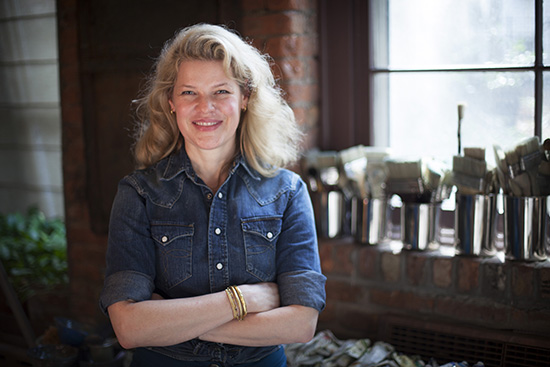
Tula Telfair paints monumental landscapes and epic-scale vistas that are simultaneously awe-inspiring and intimate. She combines stillness with motion, solitude with universality and definition with suggestion in her bold and quiet works. An extension of the progression of landscape from the backdrops of the Renaissance through the travelogues of the nineteenth century and beyond, Telfair's paintings are fully contemporary in their inspiration and execution. They demonstrate the spirit and potency of the genre adapted to a new century. Each painting calls attention to the power and fragility of the environment. Her work has been described as a meditation on the field itself, fueled by memories of her experiences living on four continents. Telfair shares with us her private vision of the beauty and majesty of the natural world. More than a single moment in time, each scene is a continuum that develops a narrative of past, present and future, indicative of nature itself. (From the Exhibition A World of Dreams)
She is a professor of Art in the Department of Art and Art History and a professor of Environmental Studies in the Bailey College of the Environment at Wesleyan University where she has taught since 1989 and served as academic dean of the Arts and Humanities and chair of the Department of Art and Art History in addition to receiving the Binswanger Prize for Excellence in Teaching. She received her BFA in 1984 from Moore College of Art and Design as a W. W. Smith Foundation Fellow and earned her MFA in 1986 from Syracuse University as a graduate fellow. Telfair has work in public collections around the world and has shown extensively in over 54 one-person exhibitions in galleries, museums, and art fairs in the United States, Bangladesh, Portugal, Canada, Sri Lanka, France, and Germany. In 2016, Abrams published a monograph on her work, Tula Telfair Invented Landscapes. She is represented by Hirschl & Adler in New York City.
“I make paintings that archive my responses to the natural world - images that I hope are both familiar and foreign. The remote locations in these invented landscapes are inspired by areas where change is rapidly occurring. My recent work is informed by visits to active volcanoes, locations where tectonic plates meet and earthquakes occur daily, the solitary Arctic and Antarctic regions, and isolated areas in Africa. I am currently doing research on shifting rivers and coastlines and their impact on the edges of the lands they border. Ultimately, I am fascinated by the subjectivity of perception and the power of memory to anchor our place in the world.
As I paint, I try to capture what it felt like moving through a location, recalling how the terrain shifted, how soft or hard it was under my feet, how the sun or wind felt coming into contact with my skin, and the smells and sounds I experienced navigating the area. These vivid yet visceral memories inform the technical decisions I make. Starting with a blank canvas, I work intuitively and the image changes countless times until the piece triggers a Déjà vu experience. The surface of each painting is extremely varied and heavily layered. Some paintings conceal more than 10 different images below the final one. I use a multitude of painting techniques, picking and choosing where and when it will be smooth or rough or creamy or thick or thin in order to facilitate a corporal reaction from the viewer. These works appear to be photographs from a distance, but as one approaches - the landscape image dissolves into an abstract, physically varied and fully material surface that also becomes a site for investigation, serving as an archive of my actions and decisions and a record of my intellectual and emotional explorations.”